jueves, 16 de julio de 2015

AND WE REACHED PLUTO


It was february of 1930 when Clyde Tombaugh discovered what untill now had been for us the most unknown and misterious body in our solar system. And I said body because once a time this "body" had been considered as a planet. I mean Pluto, the rocky planet beyond neptune that we used to see as a little dot moving among the starfield of a plate.


In average, Pluto is 4.437.000.000 kms away from the sun in his perihelion and 7.311.000.000 kms when it reaches its aphelion, so the best picture we had of it till now, was a big dot of light, thanks to the Hubble space telescope.
For a long time we had speculated about different aspects as the real size, how it would be like when it could be seen in a closer view. And now, finally we have the answer. New Horizons probe has recently unveiled this and many other secrets about Pluto, and in the next weeks, we´ll have a lot more of information that we had never dreamed with.

New Horizons Transparent.png

It was the january 19th of 2006 when New Horizons probe was launched from Cape Canaveral, on board of an Atlas V 551 rocket. Ahead of it, a vast ocean of nothing and a journey of nine years until New Horizons woke up and focus its cameras on the planet.
And  finally, on the july 14th of 2015, a dream became thruth for many people. Finally we can see Pluto in detail and his moon Charon as well.
Unfortunately, the insertion in orbit was not the goal, so what we had instead was a fast flyby close to the planet, toward the Kuiper belt. Anyway the great amount of information that we are expecting to reach ,worths it.
Some of the ashes of Clyde Tombaugh, the Pluto discoverer, were carried in the probe as a tribute to this great astronomer who died in 1997.

Pluto by LORRI and Ralph, 13 July 2015.jpg


martes, 30 de junio de 2015

CONJUNCIÓN PLANETARIA


Hoy 30 de junio de 2015 ha tenido lugar unos de los más curiosos espectáculos que la mecánica celeste nos puede brindar: Una conjunción planetaria.
Cuando se da una aproximación visual o aparente entre dos o más astros, decimos que tiene lugar una conjunción planetaria. En este caso se trata de Venus y Júpiter.
Como podéis ver en la fotografía, hay dos puntos luminosos, que son los dos planetas mencionados. Venus, es el más brillante, y justo encima tenemos a Júpiter, el gigante gaseoso que aunque parece que está a punto de tocarse con Venus, en realidad se encuentra a algo más de 700 millones de kilómetros más alla.


En esta otra vista podéis ver un "Close-up" de ambos. El brillo de Venus es bastante superior, ya que está mucho más cerca de la tierra que Júpiter. Venus dista apenas 40 millones de kilómetros de nosotros y podríamos decir que es nuestro planeta gemelo en el sistema solar, ya que casi tiene el mismo tamaño que la tierra. Eso si, la suerte de ambos fué muy diferente, ya que mientras la tierra está situada justo en plena zona de habitabilidad de nuestro sistema, Venus está en una zona mucho más caliente  y cercana a nuestra estrella. En la superficie de venus, se funden las rocas. Temperaturas de 400 grados centígrados se encargan de hacer inhabitable el planeta.


En el caso de Júpiter, hablamos de otro tipo de planeta. Mientras Venus forma parte de los denominados planetas rocosos o interiores, Júpiter pertenece al reino de los llamados "gigantes gaseosos".
Este tipo de planetas son mucho más grandes y están formados por gas principalmente y en el centro un nucleo rocoso que permanece bajo presiones inimaginables.
Júpiter es una estrella fallida, ya que si hubiese tenido un par de veces la masa que en realidad tiene, se hubiesen generado reacciones nucleares en su interior y literalmente, se habría encendido y disfrutariamos de un sistema solar con dos soles en lugar de uno, lo que significaria que durante largo períodos de tiempo, no tendríamos noche, tal y como la conocemos, y sólo cuando júpiter y el sol estuviesen juntos en la misma zona del cielo, podríamos disfrutar de cielos nocturnos.

jueves, 25 de diciembre de 2014

PROBLEMES I BENEFICIS D´UN ANTICICLÓ

Els dies previs als Nadals ens els que ens trobem immersos han estat carn d´anticicló. Normalment en aquests casos, els astrònoms ens freguem les mans amb permís de les boires, en aquesta ocasió però, en aquesta sortida de lluna nova, han fet acte de presència. I ho ha fet de la manera més rotunda i despòtica, submergint mitja catalunya allà on la temperatura no pujava dels 3 o 4 graus durant el dia, mentre al cim del Montsec, per exemple, el dia era radiant i amb certa sensació de calor nomès caminant una mica.


Aquí podeu veure un exemple de quin era el paisatge des del cim del Montsec d´Ares, tocant a Sant Alís.
Si us hi fixeu, veureu cap al centre de la imatge, a l´horitzó, on s´acaba la boira, una muntanya llunyana que surt d´entre la boira, es tracta del massis de Montserrat amb una alçada de 1236 metres. Els voltors, com s´aprecia, també vàren voler ser protagonistes.


Com es pot apreciar, a part del paisatge meravellós, no era un bon dia per al parapentistes, però el vent en altura i la bona visibilitat ens vàren regalar una visió superba del pirineu català i també de l´aragonés.
Posteriorment, de retorn a Àger, un cop submergits de nou dins el trist gris de les boires, no vàrem tenir més remei que afegir una "g" a l´astronomia i gaudir dels plats de Cal Maciarol.
Diumenge 21 al matí, vàrem fer un aplec d´amics a la taula per tal de celebrar el solstici d´hivern amb un bon esmorzar, tal i com vàrem fer ja al solstici d´estiu. Us deixo un tastet.


martes, 2 de septiembre de 2014

SUMMER TIME. REALLY?

We always are waiting for summer hollidays. Spare time, good weather, friends, and when it comes to astronomy, its very important the fact of we have the possibility of enjoy of a bunch of nights to observe, take pictures, maybe check the equipment or simply fix it after a software crash, for instance.
Well, all this is in theory, because this has been one of the worst summers that I remember in many years, astronomicaly speaking, of course.
During this ended august we have had barely few good nights from wanning moon to crescent one.
In return, soft daily temperature and almost no news about fires at the countryside.
As a result, I could only mesure a variable star and the position of two asteroids.
Regarding the fotometry of the variable star, here you have the curve.


As you can see, the seeing wasn´t very steady so the curve, despite being very obvious, it was a little bit shaking too.
Anyway, because the sort period of this star (0.068983 days), a Delta Scutii type, I "only needed" three nights in order to achieve data to get the phase.


AX Tri is placed in the Triangulum constellation, a SXPHE, coordinates 01 31 49.23 +35 13 23.9 and It almost shrinks one magnitude. Here you have more info.

Here is a phase of another variable star that I´ve been collecting along the past spring:


This is an eclipsant type EW since it has two minimums, a big one and a small one.
This kind of stars are composed by two stars, one possibly big or at least very bright and the other one smaller or darker. When one of them passes in front of the other in our line of sight, then there is an eclipse. When the smaller or darker eclipses the brighter one, the minimum falls almost one magnitude and when the brighter star is in front and the darker one is behind, the oscillation is minimum.


lunes, 28 de abril de 2014

GSC 04552-01498

 
IMÁGEN DE SITUACIÓN
   
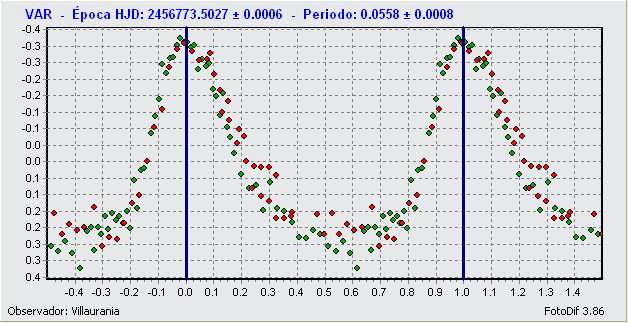
GSC 04552-01498 es una variable pulsante de período corto tipo DELTA SCT, situada en la constelación de Draco. 11 24 25.47 RA +77 42 15.3 DEC.  Magnitud 12.9 - 13., repite actividad cada 0.05581096 dias, o lo que es lo mismo, unos 80 minutos.

PERÍODO DE GSC 04552-01498

Esta es la tercera de las estrellas variables medidas desde "El teatrillo de Lyra". Su posición muy hacia el norte celeste, ha dificultado bastante el autoguiado, que ha necesitado de variar el parámetro de tiempo de calibración a casi un minuto. Finalmente ha respondido. Por otro lado, un seeing variable combinaba un comportamiento heterogéneo de la gráfica de autoguiado si comparamos la primera y la última parte de la exposición.

CURVA DE COMPARACIÓN

  • Lugar: Àger (Lleida). Observatorio "El teatrillo de Lyra" (MPC C74 / SMAL)
  • Fecha: 25 y 26/4
  • Equipo: Refractor Borg 0,08m
  • Cámara: DSLR Canon EOS 350D
  • Montura: EQ6Pro
  • Programas: Maxim DL / Fotodif
  • Tomas: 60  exposiciones de 120" la noche del viernes a sábado y 45 exposiciones de 120" la noche de sábado a domingo.

domingo, 23 de febrero de 2014

NOUS REPTES


"El Teatrillo de Lyra" encara nous reptes. Recentment ha estat acceptat com a membre de l´AAVSO (American Association of Variable Star Observers), mitjançant un e mail de benvinguda d´Elisabeth O. Waagen, Senior Technical Assistant de l´anomenada associació, on s´ens agraeix la qualitat de la primera mesura i s´ens anima a seguir col.laborant en endavant. El codi asignat a l´observatori per a mesures fotomètriques, és SMAL, així com per a astrometria és el ja conegut C74.


D´altra banda, també el nostre observatori ha passat a formar part del nou grup "Observadores de supernovas", on recentment consta com un membre més entre els ja existents, iniciant així una etapa de col.laboracions i contribucions a la ciència amb el nostre petit gra de sorra, que tant de bo serveixi per a que d´altres puguin dur a terme treballs d´importància i descobriments enriquidors.


Moltes gràcies a L´AAVSO i a "Observadores de supernovas" per la confiança depositada.


Esperem no decebre


domingo, 15 de diciembre de 2013

SUPERNOVAE


As everything in existence, stars die as well. And many of them have reserved a kind of death brilliant and explosive: We call it a Supernova.
When a dying star hasn´t "fuel" enough to keep shining, it´s own gravity pull it inside and collapse, exploding with an incredible energy with no comparation. This enormous burst not only would end with all the planets of the star, but it would wipe out all the surronding star systems too.
What happens the if a nearby star to our solar system becomes a Supernova? How would it affect us? Well it´s assumed that if it occurs in a star located within 100 light years, almost all life in our planet would dommed. If not all species were killed in the first wave, the loss of the ozone layer, will cause a fatal damage to the rest of life.
Luckily the only nearby candidate to supernova, lies more than 400 light years and it´s our old friend Betelgeus, in the Orion constellation.
So far, most of the supernovae we´ve observed, were in others galaxies and thus their light reaches us but it doesn´t mean any danger to us at all.
Last weekend I could picture that one in M74 and though it was very faint, I could mesure its magnitude that was around 17. I really woudn´t want to be its neighbour.